
 By Chandranath Chakraborty, Founder & Managing Partner · [email protected]
As tariff schedules move faster than contracts, the money is lost between the policy decision and the purchase order.
A 50 per cent tariff on Canadian goods takes effect on 19 August, following the 25 per cent imposed on Brazil in July. Inside most large companies the strategy paper responding to it has already been written, and the variance report explaining why costs rose regardless will follow some months later. The distance between those two documents has become measurable.
For Asian exporters and the companies buying from them, the policy is a moving target and the qualification clock is the constant. A supplier switch from China to Vietnam, India or Indonesia runs on the same audit, sampling and approval calendar whatever the tariff schedule says that week.
MomentumX works from that fact base through exposure mapping, contract remediation, negotiation, implementation and value delivery.
For the worked model behind this analysis, or to discuss the category: [email protected]
The intent is well documented and consistent across sources. KPMG's 2026 tariff survey finds 51 per cent of companies moving or considering moving manufacturing to the United States, with 67 per cent now treating tariffs as a structural rather than a passing risk. A separate survey by STG Logistics found 93 per cent of supply-chain leaders spreading their sourcing footprint within Asia to reduce single-country exposure. Read on their own, these figures describe a market that has already decided.
The delivery figures describe a different market. Netstock's 2026 Tariff Impact Report found that although 58 per cent of smaller businesses had considered changing suppliers in the past year, only around a third had done so, deterred by cost, lead-time risk and the capital required to qualify a new source. Research published in June found 79 per cent of American manufacturers reshoring or moving to it, against 34 per cent assessed as ready to carry it out.
Those two bodies of evidence do not reconcile, and the gap between them is the useful finding rather than either number on its own. They are measuring the same population at two different points in a sequence: one at the decision, the other at the execution. A survey that asks whether a company intends to diversify will always return a higher number than one that asks whether it has, and the interval between the two answers is where the money is lost.
The Manufacturers Alliance describes the resulting behaviour accurately — most manufacturers are building alternative capacity while maintaining their existing China supply, which is diversification rather than decoupling. That is a rational response to a qualification calendar, and it also means the exposure persists for as long as the qualification takes.
The cost of that interval turns up in filings. Hasbro recognised $17.7m of tariff cost in the first half of 2026. Executives have been candid about the difficulty of planning around the policy itself; the finance chief of Helen of Troy noted that there had been no reliable pattern to tariff reimbursements, which makes it hard to plan investment or offset disruption. Where the policy is unpredictable, the quality of a forecast stops being the variable that matters.
None of the published work measures the thing that decides the outcome, which is the qualification calendar itself. Surveys record intent and they record completion. What sits between them is a technical schedule — audit, sample, first article, regulatory notification, ramp — that varies by category, is largely indifferent to the urgency of the tariff that prompted it, and is knowable in advance for any category a business already buys.
Two decades on the buy side across Disney, Nike, Unilever and Procter & Gamble left a consistent impression of which businesses came through cost shocks intact. They were rarely the ones with the sharpest forecast. They had usually done something less visible in advance: carried a small number of approved, audited alternate sources in their most exposed categories, so that a switch was a commercial decision rather than a year-long project, and modelled each exposed category as a set of scenarios with the trigger and the response agreed beforehand.
The portfolio work this year gives a sense of how much of a book that applies to. Across the 729 companies held by 47 Asian private-equity firms that we mapped, roughly a third sit in categories where changing a source requires formal requalification against a regulatory or customer specification — packaged food, beverages, personal care, branded pharmaceuticals, contract manufacturing and research, medical devices, diagnostics, chemicals, automotive components and electronics. Those are not businesses that can respond to a tariff inside a quarter, whatever the strategy paper says.
The composition matters more than the average. A portfolio weighted towards software and services can absorb a trade shock by moving contracts. A portfolio weighted towards regulated physical goods cannot, and in the Asian books the second weighting is the larger one. An operating partner reading a portfolio-wide tariff exposure figure without that split is reading a number that means two different things in two halves of the book.
What the category engines add is that the qualification calendar is a schedule rather than an estimate. The steps are the same each time within a category, the durations sit in a range that experience has narrowed, and the sequence can be started before it is needed. That is what turns exposure from a forecasting problem into a scheduling one.
The arithmetic is worth doing in the open, because it is the part that appears in no market report and it is what decides whether a bench of alternate sources is worth funding.
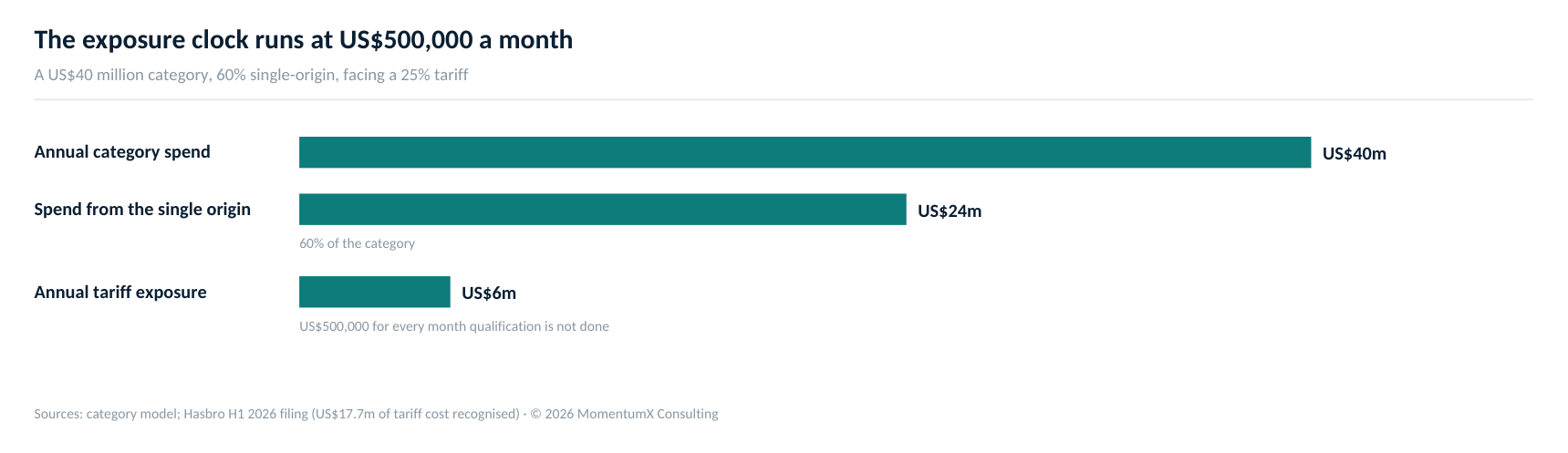
Take a category with $40m of annual spend, 60 per cent of it from a single origin, facing a 25 per cent tariff. The annual exposure is $6m, which is $500,000 a month. If the category is specification-controlled and qualification runs nine months from a standing start, then $4.5m is spent before an alternative exists to switch to. That figure is arithmetic on a schedule rather than a forecast, and it is available on the day the tariff is announced.
Against it stands the standing cost of holding a qualified alternate that is not being used: an audit, a sample and first-article run, a minimum volume allocation large enough to keep the approval live, and the engineering and quality time all of that consumes. Those costs are real and they recur. They are also, in a category of this size, an order of magnitude below $500,000 a month.
An Origin Exposure Map™ is what makes the comparison possible across a whole estate rather than one category at a time — spend by category against origin concentration, with the qualification duration attached to each line. Most organisations have never drawn it in full, which is a large part of why the exposure surprises them. The map on its own only sizes the problem; a Scenario Cost Model™ is what converts it into a decision, by agreeing in advance what triggers a switch and what the response costs in each policy state, so that when the policy moves the organisation acts rather than convenes.
The test the arithmetic produces is narrow, and deliberately so. Many categories carry origin concentration, and in most books a great many do. Far fewer carry a monthly exposure above the standing cost of holding a qualified alternative, and that shorter list is the one worth funding.
The worked file behind this piece is available on request: [email protected].
A company carrying origin concentration should stop treating diversification as a sourcing project to be initiated when a tariff lands, and fund a standing qualification bench in the categories where monthly exposure exceeds the cost of holding one. The bench is sized on exposure per month, not on expected savings, because it is bought as insurance rather than as a cost reduction. In most portfolios that means a small number of categories, chosen on the arithmetic above, rather than a programme across the estate.
The strongest argument against this is one a competent category manager would make immediately, and it deserves a straight answer. Carrying a qualified alternative that is not used costs volume leverage with the incumbent. A supplier that knows a second source is approved prices differently from one that believes it is sole. The audit and sampling work consumes quality and engineering capacity that has other claims on it, often in the same weeks as a launch. And most exposure never materialises, because tariffs are announced, delayed, litigated and reversed, so a bench funded against every plausible threat is a permanent cost against an occasional event.
The volume-leverage point is correct and should be conceded rather than argued away. Splitting a category costs something with the incumbent, and that cost belongs inside the model as a line rather than outside it as an objection. What the arithmetic does is establish where it is worth paying. In a category with $500,000 a month at risk it plainly is; in one with $15,000 a month at risk it plainly is not, and the same discipline that funds the first should refuse the second.
The point about reversal is where the disagreement is real. It argues for a narrower bench, not for none, because the asymmetry runs one way: the cost of holding an alternative that is never needed is bounded and known, while the cost of needing one that does not exist runs for as long as the qualification takes.
MomentumX can take the work through the full cycle. It starts with the exposure map and the contract file. It ends with remediated terms and the recovery verified in the accounts.
For enterprises, the immediate exposure is the interval between a tariff landing and an alternative existing, and it is measurable today in any category where origin concentration and qualification duration are both known.
For consulting firms, origin exposure is a category where a client engagement often needs a qualification calendar and a scenario model built quickly and defensibly, and where MomentumX works as a delivery partner rather than as a competitor for the relationship.
For private-equity sponsors, the portfolio-level figure conceals two very different books, and the split between requalification-bound and contract-bound businesses is usually the more actionable number.
The management challenge is constant. Which purchase orders carry the duty, and whose contract says who pays it?
For the worked model behind this article, a Confidential Spend Review of a specific category or contract, or a discussion on an APAC cost programme: [email protected]
MomentumX works from opportunity identification through commercial strategy, negotiation, implementation and value delivery.
© 2026 MomentumX Consulting
A Confidential Spend Review — a senior look at a single category or contract, on client data under a non-disclosure agreement or on an illustrative basis.
Or the Spend Exposure Index, a confidential self-assessment completed privately, with no data shared.
Written by Chandranath Chakraborty, Founder & Managing Partner, MomentumX Consulting. Two decades running procurement for The Walt Disney Company, Nike, Unilever and Procter & Gamble, with structural cost reductions above 12 per cent across a US$1B+ regional spend base in his most recent role. LinkedIn · [email protected]