
 By Chandranath Chakraborty, Founder & Managing Partner · [email protected]
As vendors reprice for AI, the renegotiation window opens on the buyer's side of the table, and most contracts sit unread while it does.
Zylo's 2026 SaaS Management Index, published this month, finds that only 54 per cent of the licences a typical enterprise pays for are used, and that 79 per cent of IT leaders met a price increase at their most recent renewal. Both figures have been broadly stable for several years. What has changed is that the pricing model underneath them is being replaced while the contracts are still being negotiated as though it were not.
The pattern holds across APAC estates. The bills are priced in US dollars whatever the operating currency. The exchange rate joins the renewal letter.
MomentumX works from that fact base through licence diagnosis, renegotiation, implementation and value delivery.
For the worked model behind this analysis, or to discuss the category: [email protected]
On governance the sources agree, and the agreement is unusually tight. Zylo puts licence utilisation at 54 per cent, equivalent to around $19.8m of waste a year, with the typical organisation running roughly 305 applications and adding nine a month. Gartner is more direct: without centralised visibility an organisation will overspend on software by at least a quarter through 2028. BetterCloud's 2026 figures describe the same estate from a different angle. A meaningful share of the spend is loose before any price is negotiated.
On inflation the numbers diverge, and the divergence is informative. Zylo's own pricing research puts the average annual increase at 8.7 per cent. The Vertice SaaS Inflation Index puts renewal rises at 12.2 per cent. Gartner has noted increases of 10 to 20 per cent from several large suppliers, and specific cases run well beyond that — Microsoft 365 raised prices across effectively every product code in July, from 16.7 per cent on Business Basic to 33 per cent on the frontline tier.
The spread is not measurement error. It reflects a split in the estate that a single average conceals: conventional applications rising at something close to general software inflation, and AI-enabled tools rising at 10 to 25 per cent, with an AI uplift of 20 to 37 per cent now itemised separately on renewal quotes. A budget built on a blended 9 per cent will be wrong in both directions at once.
Underneath sits the structural change. Gartner expects 70 per cent of businesses to prefer usage-based pricing over per-seat models by the end of 2026, and estimates $234bn of software spend exposed as AI agents work around the interfaces seat licences were built to charge for. Salesforce now runs three concurrent pricing models for the same agent capability — per conversation, per credit block, and per user per month. Suplari found 78 per cent of IT leaders had been surprised by usage-based charges and 61 per cent had cut projects when a bill moved unexpectedly.
The published research measures the estate and the price. It does not measure the contract, which is where the outcome is actually decided, and the omission matters because the two move independently. An organisation can hold a 54 per cent utilisation rate and be unable to act on it, because the agreement it signed does not permit the licence count to fall.
That clause is the thing the surveys miss. Across the category engine work, software is one of the categories where the value sits almost entirely in contract shape rather than unit price — the seat floor that ratchets but never releases, the co-termination that pulls every application to a single renewal date and destroys the leverage of negotiating them separately, the true-up mechanism that is annual in one direction and absent in the other. A buyer who wins two points of discount and leaves the floor intact has usually lost money on the transaction.
Two decades of running seat-based estates on the buy side left one observation that no reporting captures: licence counts track headcount reliably at hire and unreliably at leave. The joining process is instrumented because someone cannot work without the tool. The leaving process is not, because nothing breaks. Utilisation of 54 per cent has less to do with people ignoring software they were given than with the accumulated residue of a decade of departures. That is also the reason the number holds so steadily across organisations with nothing else in common.
The portfolio work adds a point that is specific to a private-equity reader and available nowhere in the public material. Of the 729 companies held by 47 Asian private-equity firms that we mapped this year, 137 — software, internet, and IT services and business process outsourcing — are on the selling side of this repricing. The remaining 592 are buying. A sponsor holding a diversified Asian book is therefore financing both halves of the same shift, gaining on consumption pricing in a fifth of the portfolio and paying for it across the rest, usually with no view that connects the two.
One application, taken through in the open, shows where the money actually is.
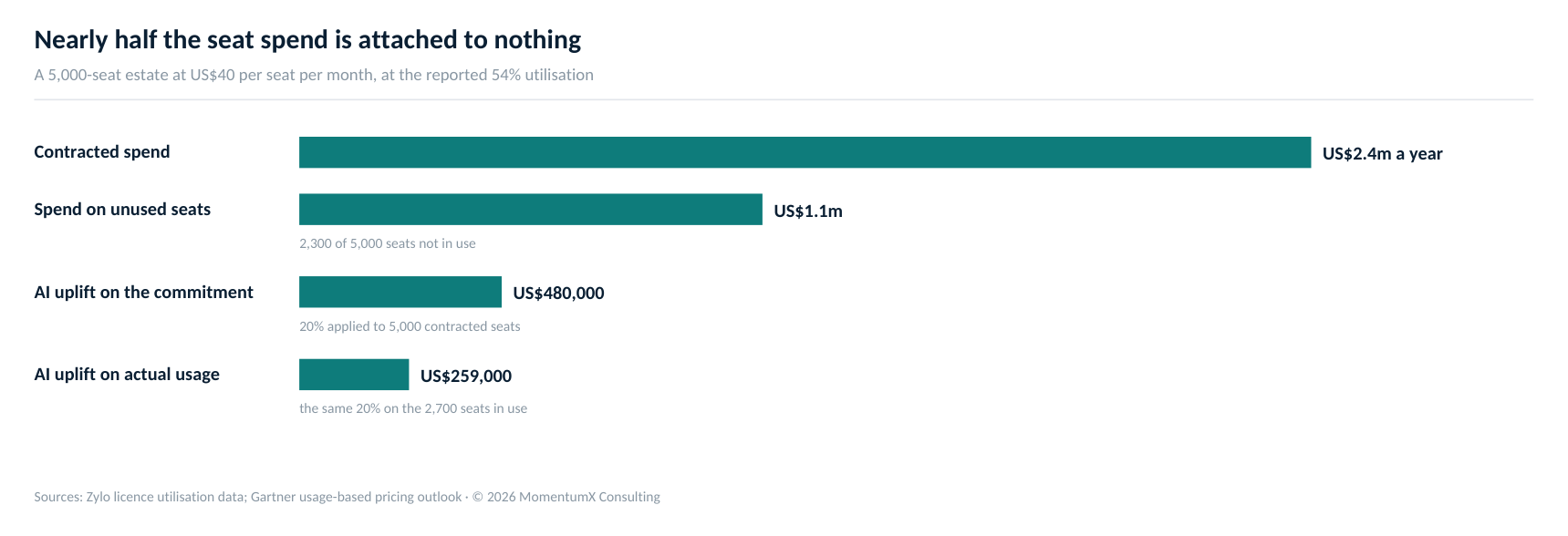
Five thousand seats at $40 per seat per month is $2.4m a year. At the reported 54 per cent utilisation, 2,700 seats are in use and 2,300 are not, which is $1.1m of annual spend attached to nothing. The obvious move is to renew at 2,700. Whether that is available depends entirely on a clause: most enterprise agreements carry a minimum commitment set at the peak count, so the contractual floor is 5,000 and the $1.1m is not recoverable at renewal however clearly it is evidenced.
Now add the AI uplift at the lower end of the reported range, 20 per cent, applied to the contracted commitment rather than to consumption. On 5,000 seats that is $480,000 a year. On 2,700 it would be $259,000. The floor has just cost a second $221,000, and it will do so again at every subsequent renewal, compounding against a base that was wrong to begin with.
The two figures price the renewal conversation. US$221,000 a year separates an uplift on the commitment from one on consumption, before a single seat is renegotiated.
A Rate-Anchored Should-Cost™ for the estate is what makes this arguable rather than assertable — an independent view of what the software ought to cost, tied to observed rates for comparable estates rather than to a negotiating instinct. It is what an incumbent finds hardest to answer, because it moves the conversation off the discount and onto the shape.
What follows from it is a Software Value Reset™ built in a specific order, and the order is the point. Release the floor first, since nothing else can be claimed until the count can move. Meter consumption and cap it second. Take flexibility between seats and consumption third, so that work migrating from a person to an agent does not get charged twice. Shorten the term and attach a benchmarking provision last. A buyer who negotiates the discount first has spent the leverage on the least valuable of the five.
The worked file behind this piece is available on request: [email protected].
A CFO facing a renewal in the next twelve months should instruct that the negotiation is about contract shape rather than headline rate, and should be willing to accept a worse unit price to obtain the right to reduce the licence count and a cap on the consumption line. The measured waste is larger than any discount likely to be won, and it recurs every year the floor stays in place.
The strongest argument against comes from anyone who has sat on the other side of the table. A supplier will price flexibility, and price it well, because it knows exactly what the option is worth. A buyer who trades unit price for the right to reduce may pay for an option it never exercises, having given up a certain saving for a contingent one. Shortening the term forfeits the multi-year discount, which is real money. And a chief financial officer is measured, at the audit committee, on the renewal delta against last year — a number that a reshaped contract can worsen in the year it is signed even where it is plainly the better agreement.
The first objection is correct and the answer is arithmetic rather than argument. The option is worth buying where its price is below the measured waste, and at 54 per cent utilisation on a large estate it usually is by a wide margin. Where utilisation is genuinely high the calculation reverses and the discount is the better trade. The point is that almost nobody measures which case they are in before deciding.
The third objection is not answered here, and it should not be pretended away. Procurement cannot fix a measurement regime that rewards the renewal delta and is blind to contract shape. What it can do is present both numbers, so that the trade is made deliberately by the person accountable for it rather than by default.
MomentumX can take the work through the full cycle. It starts with the licence file and the usage record. It ends with repriced agreements and the saving verified in the accounts.
For enterprises, the exposure is a renewal calendar that will be worked in the wrong order, and it is visible now in any agreement whose minimum commitment was set at a headcount peak that has since passed.
For consulting firms, software estates are a category where an engagement often needs an independent should-cost and a contract-shape assessment built inside a few weeks, and where MomentumX works as a delivery partner rather than as a competitor for the relationship.
For private-equity sponsors, an Asian book sits on both sides of this repricing at once, and the portfolio view that nets the two is not usually being drawn.
The management challenge is constant. What does the estate actually use, and what does the contract say the unused part costs?
For the worked model behind this article, a Confidential Spend Review of a specific category or contract, or a discussion on an APAC cost programme: [email protected]
MomentumX works from opportunity identification through commercial strategy, negotiation, implementation and value delivery.
© 2026 MomentumX Consulting
A Confidential Spend Review — a senior look at a single category or contract, on client data under a non-disclosure agreement or on an illustrative basis.
Or the Spend Exposure Index, a confidential self-assessment completed privately, with no data shared.
Written by Chandranath Chakraborty, Founder & Managing Partner, MomentumX Consulting. Two decades running procurement for The Walt Disney Company, Nike, Unilever and Procter & Gamble, with structural cost reductions above 12 per cent across a US$1B+ regional spend base in his most recent role. LinkedIn · [email protected]