
 By Chandranath Chakraborty, Founder & Managing Partner · [email protected]
As AI spend accumulates across licences, tokens and embedded features, it forms a category almost nobody manages.
There is a category taking shape inside most large companies that few are managing. It is already substantial, growing at close to half a year on Gartner's figures, and in many organisations it has no owner, no strategy and no total that anyone can state with confidence. The research on what it returns has meanwhile grown noticeably more sober.
APAC buyers meet it with a lag. The charges arrive in dollars, the governance sits with regional IT, and the aggregated number surfaces at group level after the year has run.
MomentumX works from that fact base through spend mapping, governance design, negotiation, implementation and value delivery.
For the worked model behind this analysis, or to discuss the category: [email protected]
The spending is not in dispute. Gartner places worldwide AI spending on course for roughly $2.59tn this year, an increase of about 47 per cent. At the level of an individual organisation the growth reported is steeper still, with enterprise AI spend up 108 per cent year on year to an average of $1.2m and 78 per cent of technology leaders encountering charges they had not budgeted for.
On returns the sources are directionally aligned and numerically far apart, and the gap is the more interesting finding. MIT's work found 95 per cent of enterprise AI pilots producing no measurable effect on profit or loss. RAND concluded that more than 80 per cent of projects fail to deliver their intended value. S&P Global reported 42 per cent of companies abandoning most of their AI projects during 2025. IBM put the proportion delivering their expected return at around a quarter, which implies a failure rate of roughly 75 per cent.
Read carelessly, four numbers between 42 and 95 per cent look like disagreement about whether AI works. Read properly they are measuring four different things: a pilot that never reached production, a project that reached production and missed its case, a programme abandoned, and an initiative that fell short of a stated return. The spread is a symptom of a category with no agreed definition of success, which is itself the point. A cost line that cannot be assessed consistently cannot be governed consistently either.
The governance evidence is the least ambiguous of it. Suplari's 2026 benchmark of 121 procurement teams found 47 per cent using AI daily against 17 per cent with an enforced governance policy. Governance now absorbs 8 to 12 per cent of the average enterprise AI budget, against 3 to 5 per cent two years ago, so the spending on control is rising faster than the control itself. IBM's breach research puts the cost of an incident involving substantial unsanctioned AI use at roughly $670,000 above one without.
The published work treats AI as a technology programme that is failing to return its investment. Its cost behaviour is that of a consumption utility, and it belongs in the same family as electricity, telecommunications and cloud compute rather than in the family of software projects — bought continuously rather than periodically, consumed by people who never see the price, and billed after the fact on a meter nobody reads.
Running an index monitor across twenty-five public cost-driver series makes one absence conspicuous. Ocean freight has Drewry. Japanese input costs have the Bank of Japan's corporate goods price index. Enterprise software has Vertice. Metals, energy and chemicals all have settled public benchmarks that a buyer can hold a quotation against. AI compute has nothing comparable — no published series, no independent index, no external anchor of any kind against which a usage bill can be judged. That is the structural reason the category resists governance, and it is not a failure of diligence by the people buying it.
The consequence is specific. In every other consumption category the buyer's defence is external: a rate can be shown to be off-market, and the supplier knows it can be. In AI the only available reference is the organisation's own history, which is short, rising, and produced under exactly the conditions being questioned. A finance function asking whether a bill is reasonable has nothing to compare it to, and a supplier negotiating that bill is aware of the asymmetry. Published list prices for inference exist, but they describe a headline tariff rather than what large buyers actually pay, in the way that a published freight rate card would if no index sat behind it.
The pattern itself is familiar from two decades on the buy side. Maverick spend in indirect categories behaved the same way — many small commitments, each below the threshold, aggregating into a line nobody had approved. What differs is the compounding. A signed contract holds its value until renewal. A meter runs continuously, and a usage curve that doubles in a year does so without anyone taking a second decision.
The mechanism is best seen at the size where it actually operates, which is far below the level any approval process is set to catch.
One team of 200 people enables an AI feature in a tool they already licence. Each person runs forty queries a day at roughly 2,000 tokens a query, which is 16 million tokens a day. At $0.002 per thousand tokens that is about $32 a day, or a little under $8,000 a year. No approval threshold in any large company is set at $8,000, and none should be. Ten teams doing the same thing is $80,000. Fifty is $400,000, arriving as line items on invoices for products that were competed and approved years ago, attributed to no cost centre and owned by nobody.
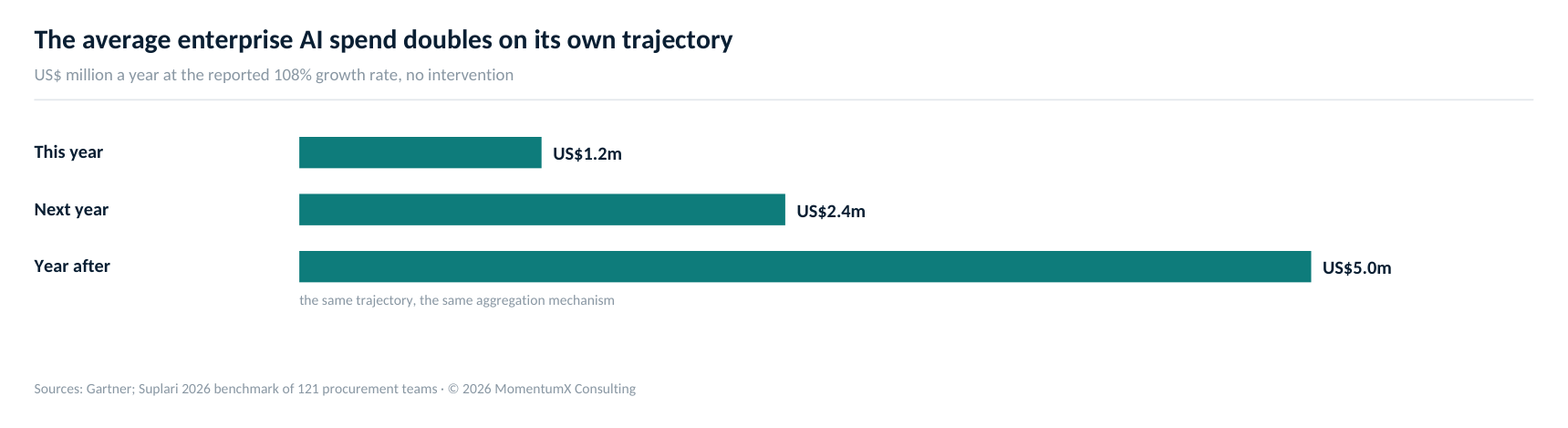
Against an average enterprise AI spend of $1.2m growing at 108 per cent, the arithmetic of doing nothing is straightforward: $2.4m next year and $5m the year after, on the same trajectory and by the same mechanism.
What makes this hard to argue rather than merely assert is the missing anchor described above. A Rate-Anchored Should-Cost™ for a category normally ties each number to an observable external rate. Where no such rate is published, the anchor has to be constructed — from unit economics that are visible, from comparable consumption categories, and from the cited public references held in the MomentumX Benchmark Basis™. It is more work than a category with a public index requires, and it is the difference between a bill that can be challenged and one that can only be paid.
The remedy that follows from the arithmetic is narrow. Since the problem is aggregation rather than approval, the fix is to change what gets counted: a cumulative annual threshold per supplier and per capability, rather than a per-transaction one. That single change makes the $400,000 visible without placing a single one of the fifty teams in front of a committee.
The worked file behind this piece is available on request: [email protected].
AI should be managed as a consumption utility rather than as a technology programme. In practice that means three things a CFO can instruct this quarter: meter usage and attribute it to a cost centre, replace the per-transaction approval threshold with a cumulative one per supplier, and require that any capability moving from trial to production carries a funded line and a named owner. None of that governs what teams may do. It governs whether anyone can see the total.
The argument against is a serious one and it is being made in good faith. Governance slows adoption at precisely the moment when speed has competitive value, and a firm that spends 2026 instrumenting its AI spend while a rival spends it deploying may find the saving was expensive. Eight to twelve per cent of an AI budget consumed by control is a heavy tax on a category whose returns are already in question. And the market appears to be correcting on its own: enterprises are reported to be deferring a quarter of planned AI spend into 2027, which is a discipline arriving without anyone imposing it.
The point about speed is right about approval gates and wrong about visibility, and the two get conflated. A governance function that reviews each request is the wrong answer, and it is the answer most organisations reach for. Counting is not reviewing. A cumulative threshold and a cost-centre attribution slow nothing down; they simply mean that when the total reaches a size worth a decision, a decision becomes possible.
The deferral point is the stronger objection and it should be conceded in part. Some of this category will shrink without intervention, either because the spending is postponed or because model costs fall. What that does not address is attribution. A firm that defers a quarter of its planned spend and still cannot say what the remaining three quarters bought has postponed the bill rather than answered the question.
MomentumX can take the work through the full cycle. It starts with the spend map across licences, usage and embedded features. It ends with a governed category and the saving verified in the accounts.
For enterprises, the exposure is a line growing at close to double a year that no approval process is built to see, and the first useful step costs nothing beyond counting.
For consulting firms, AI cost is a category where a client engagement needs a should-cost built without a public index to lean on, which is slow work to do from a standing start, and where MomentumX works as a delivery partner rather than as a competitor for the relationship.
For private-equity sponsors, an uninstrumented AI line is a diligence question as much as an operating one, since a cost growing at this rate without attribution will not behave predictably through a hold period.
The management challenge is constant. Who owns the AI spend, and what did it total last quarter?
For the worked model behind this article, a Confidential Spend Review of a specific category or contract, or a discussion on an APAC cost programme: [email protected]
MomentumX works from opportunity identification through commercial strategy, negotiation, implementation and value delivery.
© 2026 MomentumX Consulting
A Confidential Spend Review — a senior look at a single category or contract, on client data under a non-disclosure agreement or on an illustrative basis.
Or the Spend Exposure Index, a confidential self-assessment completed privately, with no data shared.
Written by Chandranath Chakraborty, Founder & Managing Partner, MomentumX Consulting. Two decades running procurement for The Walt Disney Company, Nike, Unilever and Procter & Gamble, with structural cost reductions above 12 per cent across a US$1B+ regional spend base in his most recent role. LinkedIn · [email protected]